
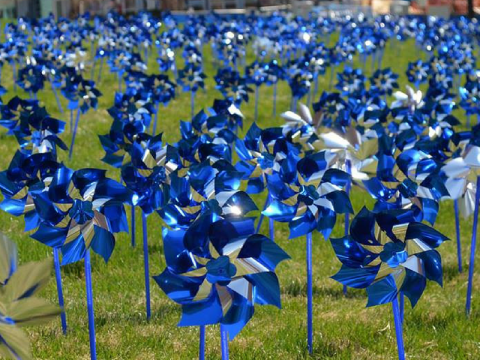
During April, we recognize National Child Abuse Prevention Month and the importance of working together to support and strengthen families and prevent child maltreatment. Throughout the year, communities are encouraged to increase awareness about child and family well-being and work together to implement effective strategies that support families and prevent child abuse and neglect.
PINWHEELS
Prevent Child Abuse America started the Pinwheels for Prevention campaign in 2008 to create a national effort to change the public’s beliefs and behaviors regarding child abuse and neglect prevention. The pinwheel represents our efforts to change the way our nation thinks about prevention, focusing on community activities and public policies that prioritize prevention right from the start to make sure child abuse and neglect never occur.
For more information, visit the official Pinwheels for Prevention website.

“When we plant the blue pinwheels, hopefully, it’s to demonstrate to others what April is all about. It’s a child abuse prevention month… and the blue represents bruises that kids might have. We wear blue and we have blue pinwheels in solidarity for kids who have experienced abuse.”
 Holly Area Youth Assistance
Also, “[even] well-meaning and loving parents can unintentionally do harm to a child if they are not well informed about human development” (Childhood Disrupted, pg.24).
Therefore, failing at parenthood can occur as soon as the decision is made to conceive and carry a baby to term.
By this I don’t mean they necessarily are or will be ‘bad’ parents. Rather, it’s that too many people will procreate regardless of not being sufficiently knowledgeable of child development science to parent in a psychologically functional/healthy manner.
They seem to perceive thus treat human procreative ‘rights’ as though they (potential parents) will somehow, in blind anticipation, be innately inclined to sufficiently understand and appropriately nurture their children’s naturally developing minds and needs.
As liberal democracies we cannot or will not prevent anyone from bearing children, even those who recklessly procreate. We can, however, educate young people for this most important job ever, even those who plan to remain childless, through mandatory high-school child-development science curriculum.
While it wouldn’t be overly complicated, it would be notably more informational than diaper changing and baby feeding, which often are already covered by home economics [etcetera] curriculum.
If nothing else, such child-development science curriculum could offer students an idea/clue as to whether they’re emotionally suited for the immense responsibility and strains of parenthood. Given what is at stake, should they not at least be equipped with such valuable science-based knowledge?
After all, a mentally as well as physically sound future should be every child’s fundamental right — along with air, water, food and shelter — especially considering the very troubled world into which they never asked to enter; a world in which Child Abuse Prevention Month [every April] clearly needs to run 365 days of the year.
_________
“I remember leaving the hospital thinking, ‘Wait, are they going to let me just walk off with him? I don’t know beans about babies! I don’t have a license to do this. We’re just amateurs’.”
—Anne Tyler, Breathing Lessons
“It’s only after children have been discovered to be severely battered that their parents are forced to take a childrearing course as a condition of regaining custody. That’s much like requiring no license or driver’s ed[ucation] to drive a car, then waiting until drivers injure or kill someone before demanding that they learn how to drive.”
—Myriam Miedzian, Ph.D.
“The way a society functions is a reflection of the childrearing practices of that society. Today we reap what we have sown. Despite the well-documented critical nature of early life experiences, we dedicate few resources to this time of life. We do not educate our children about child development, parenting, or the impact of neglect and trauma on children.”
— Dr. Bruce D. Perry, Ph.D. & Dr. John Marcellus
“It has been said that if child abuse and neglect were to disappear today, the Diagnostic and Statistical Manual would shrink to the size of a pamphlet in two generations, and the prisons would empty. Or, as Bernie Siegel, MD, puts it, quite simply, after half a century of practicing medicine, ‘I have become convinced that our number-one public health problem is our childhood’.”
— Childhood Disrupted, pg.228
LikeLike